November 6, 2026 · 9 min read · Eco Roofing Ltd, Nanaimo
Flat roofs are more common in Nanaimo than many homeowners realize. Additions, garages, sunrooms, carports, and modern-style homes across Vancouver Island often have a flat or low-slope section, and those sections need a very different kind of roof from the pitched shingle roofs most people picture. A flat roof cannot shed water the way a steep slope does, so the material itself has to be watertight. That is exactly what torch-on roofing is built to do.
Torch-on roofing, also called modified bitumen, has been used on flat roofs across Canada for decades. It is a tough, flexible membrane that is heat-welded into a seamless waterproof skin, and it handles our Island climate well: months of steady rain, occasional snow, salt air near the harbour, and the freeze-thaw cycles of a coastal winter. This guide explains how torch-on roofing works, what makes a good installation, what maintenance it needs, and when it is the right choice for your home.
What is torch-on roofing?
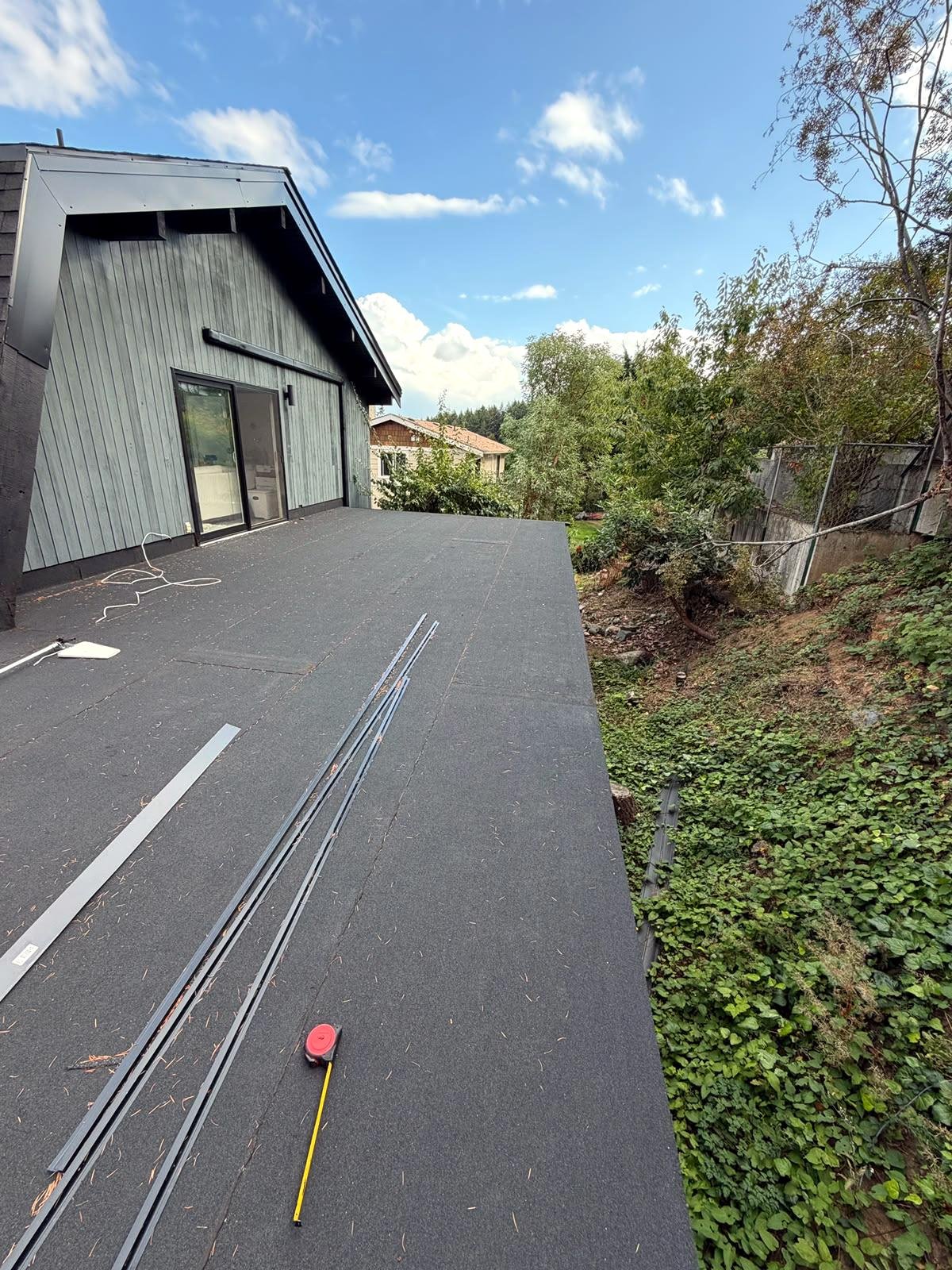
Torch-on roofing is a two-layer membrane system made from modified bitumen, which is asphalt that has been blended with rubber or plastic polymers to make it flexible and durable. It comes in rolls. The base sheet is fastened or adhered to the roof deck, and then the cap sheet is applied on top using an open-flame torch. The heat melts the underside of the cap sheet, fusing it to the base sheet and sealing the seams into one continuous waterproof layer.
The finished membrane is thick, rubbery, and seamless. Unlike a shingle roof, which sheds water by overlapping pieces, a torch-on roof is waterproof because the membrane itself is waterproof, including at the seams. That is why it works on flat and low-slope roofs where water can sit for a while after a heavy rain. The cap sheet usually has a mineral granule surface, similar in feel to a shingle, which protects the bitumen from UV damage and gives the roof a finished look.
If you want a broader comparison of flat roof systems, our guide to flat roofing options in Nanaimo covers torch-on alongside single-ply membranes. The short version is that torch-on is the proven, workhorse choice: heavier and more forgiving than most alternatives, with a long track record on Island homes and commercial buildings alike.
Why torch-on suits Nanaimo and Vancouver Island
Built for standing water and heavy rain
Nanaimo gets long stretches of steady rain through fall and winter, and a flat roof has to cope with water that does not run off quickly. Ponding, which is water that sits on a roof for a day or more after rain, is the number one enemy of flat roofs. A torch-on membrane is designed for exactly this: the fused seams do not open up under standing water the way a glued or mechanically fastened seam can. That is a real advantage in a climate where the roof is wet for much of the year.
Flexible through freeze and thaw
Coastal winters on Vancouver Island are mild by Canadian standards, but the temperature still crosses freezing regularly, especially overnight and in shaded areas around Duncan and the Island interior. Materials that get brittle in the cold crack at the seams and at flashing details. The polymers in modified bitumen keep the membrane flexible in cold weather, so it expands and contracts with temperature changes without splitting. That flexibility is one of the reasons torch-on roofs last as long as they do here.
Tough enough for foot traffic and debris
Flat roofs get walked on more than pitched roofs: for gutter cleaning, Christmas lights, satellite dishes, heat pump servicing, and moss treatment. A thin single-ply membrane can be punctured by a dropped tool or a sharp branch. Torch-on membrane is thick and multi-layered, so it tolerates normal foot traffic and the occasional fallen branch far better. It is also easy to patch: a damaged area can be cut out and a new piece torched in, and the repair fuses into the surrounding membrane just like the original seams.
Good on complex shapes and details
Flat roofs rarely come as a simple rectangle. There are skylights, vents, parapet walls, drains, and the junction where a flat addition meets a pitched main roof. These details are where flat roofs leak, and torch-on is particularly good at them because the membrane can be wrapped up walls, around curbs, and into corners, then heat-sealed in place. A skilled torch-on crew can make watertight details that would be difficult or impossible with a rigid panel system.
How torch-on roofing is installed
A torch-on installation starts with the deck. The existing roof covering is usually stripped back so the crew can inspect the deck underneath, because torch-on should never be laid over a rotten or soft deck. Damaged plywood is replaced, and the deck is swept clean and dry. Any slope correction happens at this stage too: a flat roof still needs a slight fall toward its drains, and if water has been ponding badly, tapered insulation may be added to improve drainage before the membrane goes on.
Next comes the base sheet, which is fastened or adhered to the deck depending on the system and the building. Then the cap sheet is unrolled in sections and torched down, with each roll overlapping the last. The torch work is the skilled part of the job: too little heat and the seam will not fuse, too much and the membrane can be damaged. A good crew works in a steady rhythm, checking seams as they go and rolling them flat while the bitumen is still hot. Flashings at walls, drains, and vents are finished with the same technique, and the whole roof is inspected seam by seam before the crew leaves.
One thing homeowners should know: the open flame is a real fire risk, and it is the main reason torch-on work should only be done by experienced, insured professionals. A reputable crew carries the right insurance, keeps fire extinguishers on the roof, watches for smouldering in the deck and walls, and stays on site for a fire watch after the torch is put away. If a contractor cannot explain their fire safety procedure, that is a reason to look elsewhere. Never hire a torch-on crew working without insurance.
The one question to ask any torch-on contractor
Ask who will actually be on the roof with the torch, and how many torch-on roofs they have installed. The membrane is only as good as the seams, and the seams are only as good as the person holding the torch. Experience is not a nice extra here. It is the whole job.
How long does a torch-on roof last?
A well-installed torch-on roof on Vancouver Island typically serves for decades, and it is not unusual for one to outlast the shingle roof on the rest of the same house. The exact lifespan depends on the membrane quality, the installation, the drainage, and how well the roof is maintained. The cap sheet's granule surface protects the bitumen from UV, which is the main cause of ageing, so keeping that surface intact matters more than most homeowners realize.
Drainage is the other big factor. A torch-on roof that drains well will last far longer than one where water ponds for days after every rain. Standing water does not damage a healthy torch-on membrane quickly, but it accelerates wear at seams and flashings, encourages moss and algae growth, and adds weight the structure was not designed to carry. If your flat roof holds puddles long after the rain stops, that is worth fixing, whether the membrane itself is torch-on or something else.
Torch-on maintenance: what it actually involves
Torch-on roofs are low maintenance compared with cedar or shingles, but low maintenance is not no maintenance. The most useful job is a twice-yearly clear-out: remove leaves, needles, and debris from the roof surface and especially from drains, scuppers, and gutters. On Vancouver Island, autumn leaf fall and winter storms can block a flat roof drain in a matter of weeks, and a blocked drain turns a flat roof into a shallow pond. Clearing drains is a quick job that prevents the most common flat roof problems.
Moss and algae deserve attention too. They grow readily on the granule surface in our damp climate, particularly on shaded and north-facing sections. A light growth is mostly cosmetic, but heavy moss holds moisture against the membrane and can lift granules over time, exposing the bitumen underneath to UV. Treat moss with a product suited to roofing membranes, applied gently, and avoid pressure washing, which strips granules and shortens the membrane's life. A roofer can include moss treatment in a regular inspection visit.
An annual professional inspection is worth the small effort it takes to arrange. A roofer will check the seams, the flashing details, the condition of the granule surface, and any areas where the membrane has blistered or lifted. Catching a seam that is starting to open, or a flashing that has pulled away from a wall, is a minor repair when found early. Left for a season or two, the same problem becomes a leak into the ceiling below, and the repair gets much bigger. For a flat roof, where a leak can travel sideways before it shows inside, early inspection matters even more than on a pitched roof.
Signs your torch-on roof needs attention
- Water stains on the ceiling below a flat roof section, or damp patches that appear after rain and dry out slowly.
- Blisters or bubbles in the membrane, which mean moisture or air is trapped underneath and the bond is failing.
- Seams that are lifting, curling, or visibly open, especially at edges, corners, and around drains.
- Bare patches where the granule surface has worn away, leaving the black bitumen exposed to sun.
- Ponding water that is still there more than two days after the rain stops, which points to a drainage problem.
- Cracks or splits in the membrane, often near flashing details or where the roof meets a wall.
- A roof that is past the age where your roofer says the membrane is nearing the end of its service life.
If you are seeing several of these signs at once, the roof is telling you it needs professional attention. A single blister or a small area of granule loss can often be repaired, but widespread seam failure or cracking usually means the membrane has reached the end of its useful life. If you are unsure which situation you are in, a free inspection will settle it. Our guide to roof replacement vs repair in Nanaimo explains how roofers make that call.
Torch-on vs other flat roof options
The main alternative to torch-on on Vancouver Island is a single-ply membrane, usually TPO or EPDM. Single-ply membranes are lighter and can be installed without an open flame, which removes the fire risk during installation. They are a good choice for some buildings, particularly large commercial roofs. For most Island homes, though, torch-on has two advantages that matter: it is thicker and more puncture-resistant, and its seams are fused by heat into the membrane itself rather than glued or taped. In a climate where roofs are walked on, rained on for months, and covered in needles and leaves, that toughness counts.
Built-up roofing, the old tar-and-gravel system, is still around but is becoming rare on residential work. It is heavy, messy to install, and harder to repair neatly than torch-on. If you have an old tar-and-gravel roof, replacing it with torch-on is the most common upgrade path, and the existing gravel and tar usually come off first so the deck can be inspected. If your flat roof currently has another system and you are weighing a change, ask your roofer to compare torch-on against your current material for your specific roof, including its slope, drainage, and how the space below is used.
When torch-on is the right choice, and when it is not
Torch-on is the right choice for most flat and low-slope residential roofs in Nanaimo, Parksville, Duncan, Ladysmith, and Qualicum Beach: additions, garages, carports, and modern homes with flat sections. It is the right choice when the roof will be walked on for maintenance, when there are lots of details like skylights and parapets to seal, and when you want a proven system with a long local track record. It is also the right choice when the existing roof is torch-on and the deck is sound, since a new torch-on system can sometimes be installed over a well-adhered existing membrane, saving the cost of a full strip.
Torch-on is not the right choice for a pitched roof. It is designed for flat and low-slope surfaces, and putting it on a steep slope makes no sense when shingle roofing or metal roofing will shed water far better and look far better doing it. It is also not the best choice if the building structure cannot take the weight of a two-layer membrane system, though this is uncommon on residential homes, or if the roof has no safe way to manage the open flame during installation, such as combustible materials tight against the deck with no access. A professional roofer will flag these situations during an inspection rather than after the work has started.
Getting a torch-on roof quote in Nanaimo
A proper torch-on quote starts with an inspection of the roof itself: the deck condition, the drainage, the details, and the access for the crew and materials. A good quote will name the membrane product, the number of layers, the insulation if any is needed, and the flashing details, so you can compare quotes fairly instead of guessing what each one includes. It should also state the warranty on both the materials and the workmanship, since the two are separate and both matter. If a quote is vague about the product or the scope, ask for the details in writing before you decide.
When you compare roofers, ask specifically about torch-on experience, since it is a different skill from shingle work. Ask to see recent local torch-on jobs, ask how they handle fire safety and the post-installation fire watch, and ask what they do about drainage if your roof ponds. A roofer who has installed torch-on across Nanaimo for years will have ready answers to all of those questions. Eco Roofing Ltd installs torch-on roofing and flat roofing across Nanaimo, Parksville, Duncan, Ladysmith, and Qualicum Beach. Request your free quote or call (250) 240-3684 to book an inspection of your flat roof.
Not sure what your roof needs?
Get a free inspection and an itemized written quote. No obligation, no pressure, just a straight answer from a local Nanaimo roofer.